
Sentri
Get fast fault clearing without compromising system coordination.
Electrical protection systems are often designed to choose between two competing priorities: clearing faults quickly to reduce equipment damage and arc flash energy, or coordinating protection devices to keep the rest of the facility online. Achieving one has traditionally meant compromising the other.
Often, an electrical system is protected by a single relay on the main service breaker. That works until a fault happens anywhere in the system, at which point the entire service goes down to clear it, whether the fault was on a small branch circuit or the main feed.
To avoid that kind of blanket disruption, it is common practice to set the main breaker’s protection to maximum pickup and maximum delay, or in some cases to disconnect from ground fault protection entirely. That approach does reduce nuisance shutdowns but, it also means that when a real fault does occur, it takes longer to clear. A longer clearing time leads to more energy being released and more equipment damage before the breaker finally opens.
This coordination problem lies underneath most arc flash risk. The system is defended in a way that trades clearing speed for continuity which shows up as damage when a fault actually happens.
Selective ground fault protection exists to solve this trade-off in two forms:
Time Coordinated Protection (TCP) achieves selectivity by giving each level of the system a longer time delay than the level below it. It works, but every level above the fault waits out its delay even though the relay closest to the fault could have tripped instantly.
Zone Selective Instantaneous Protection (ZSIP) achieves the same selectivity without the wait. Each relay trips instantly unless it receives a restraint signal from the relay in the zone directly below it. If it receives that signal, it holds off just long enough for the downstream relay to clear the fault first. If the fault is in its own zone and nothing downstream is restraining it, it trips immediately.
The practical difference is clearing time at every level except the one closest to the fault. Clearing time is what determines how much equipment damage and how much energy release a given fault produces.
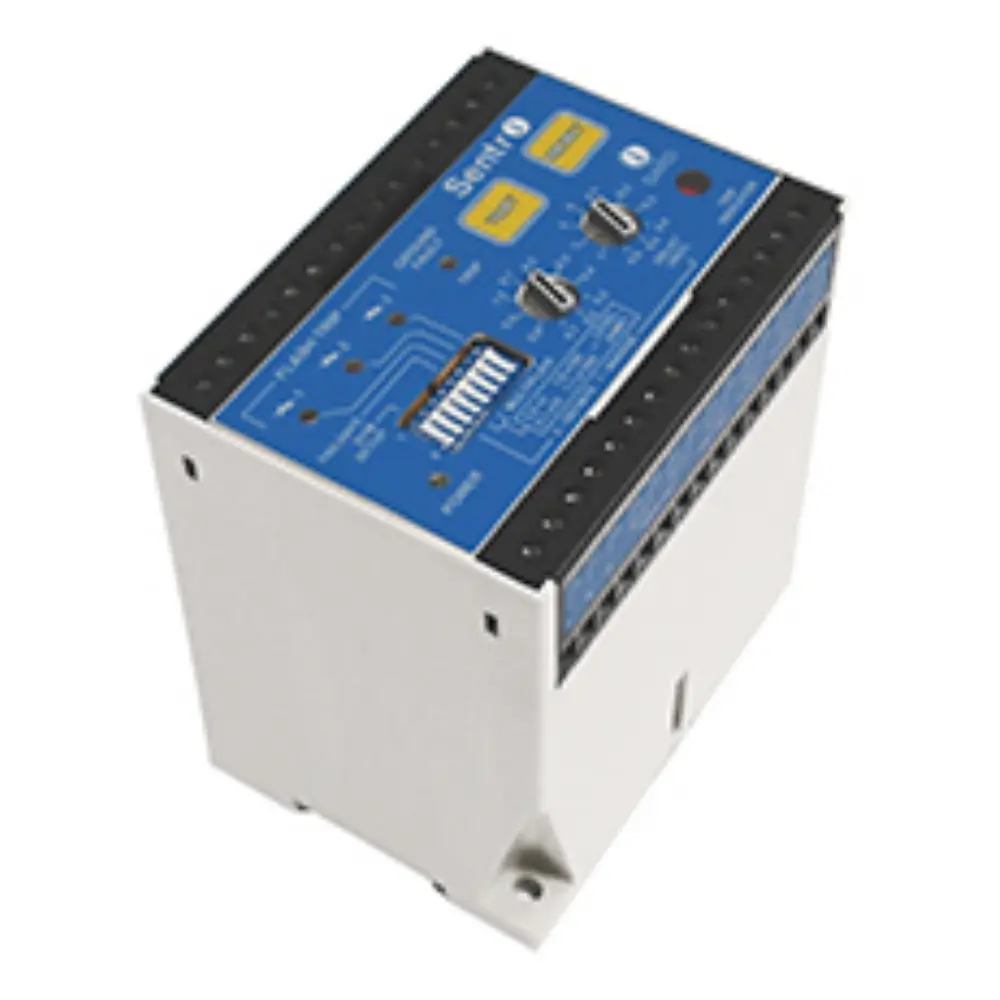
Sentri
Sentri combines ground fault protection, Zone Selective Instantaneous Protection (ZSIP), and arc flash detection in a single relay. It covers ground fault trip levels from 100 mA to 1200 A across 40 settings, works on both solidly grounded and resistance grounded systems, and accepts up to three optical arc flash sensors that trip in under 1 millisecond.
It also includes a pre-trip alarm contact for early warning before the main relay operates, and connects to an I-Gard mGARD-SYM remote display for Modbus connectivity, live current monitoring, and remote setup and reset across up to 50 devices on a single address.
One Relay, Two Jobs
Ground fault and arc flash detection live in the same device, so you are not coordinating two separate systems to protect against the same escalation path.
Speed without Sacrifice
ZSIP lets the relay closest to a fault trip instantly, while everything upstream keeps running avoiding a choice between fast tripping and system-wide coordination.
Advanced Warning
The pre-trip alarm flags a developing ground fault before the main relay actually operates, giving operations a chance to respond before service is interrupted.
Effortless Visibility
The mGARD-SYM connection puts settings, live current readings, and remote reset in one place up to 50 devices, without walking the floor to every relay individually.
How Sentri Works
Sentri combines ground fault protection, Zone Selective Instantaneous Protection, remote monitoring, and arc flash mitigation in a single relay. It is rated for 40 discrete trip levels from 100 mA up to 1200 A, and it works on both solidly grounded and resistance grounded systems.
Ground fault protection and ZSIP
Sentri connects to a zero-sequence current sensor and trips on ground fault current at the level you set. With ZSIP enabled, it trips with no intentional delay unless a Sentri relay downstream sends a restraint signal, in which case it waits out its own delay setting to give the downstream relay the chance to clear the fault first. This can be extended across any number of zone levels in a facility.
Arc flash detection
In addition to ground fault protection, Sentri accepts up to three optical arc flash sensors. Each one is tuned to the infrared range and, once tripped, closes its corresponding flash relay in under 1 millisecond. The main trip relay follows in approximately 7 milliseconds. Each flash relay is solid state for speed, backed up in parallel by a dry contact mechanical relay.
Pre-trip alarm
A separate, normally open dry contact closes to warn a remote panel or monitor when ground fault current crosses a pre-trip threshold, by default 50 percent of the main trip level, before the main relay actually trips. This gives operations a warning that a fault is developing, not just a report that one already happened.
Remote monitoring
Sentri connects to an I-Gard mGARD-SYM remote display over Modbus. From there you can view and change trip level and delay settings without the restriction of the relay’s own discrete faceplate switches, monitor real time current, and remotely test and reset the relay. A single mGARD-SYM address can monitor up to 50 compatible devices, with a maximum of 42 Sentri relays on one address.
Optional pressure arc detection. Sentri’s datasheet lists a Pressure Arc Detector system that senses the incipient stages of an arc’s pressure wave and issues a trip signal within 10 milliseconds. The instruction manual’s own pressure sensor specification lists an 8-millisecond response time with a 50 psi lower threshold.
Standards and Compliance
Data center electrical systems are commonly designed and maintained in accordance with:
Typical Applications

Data Centers 
Petrochemical 
Water and Waste Water Plants 
Automotive Manufacturing 
Data Centers